
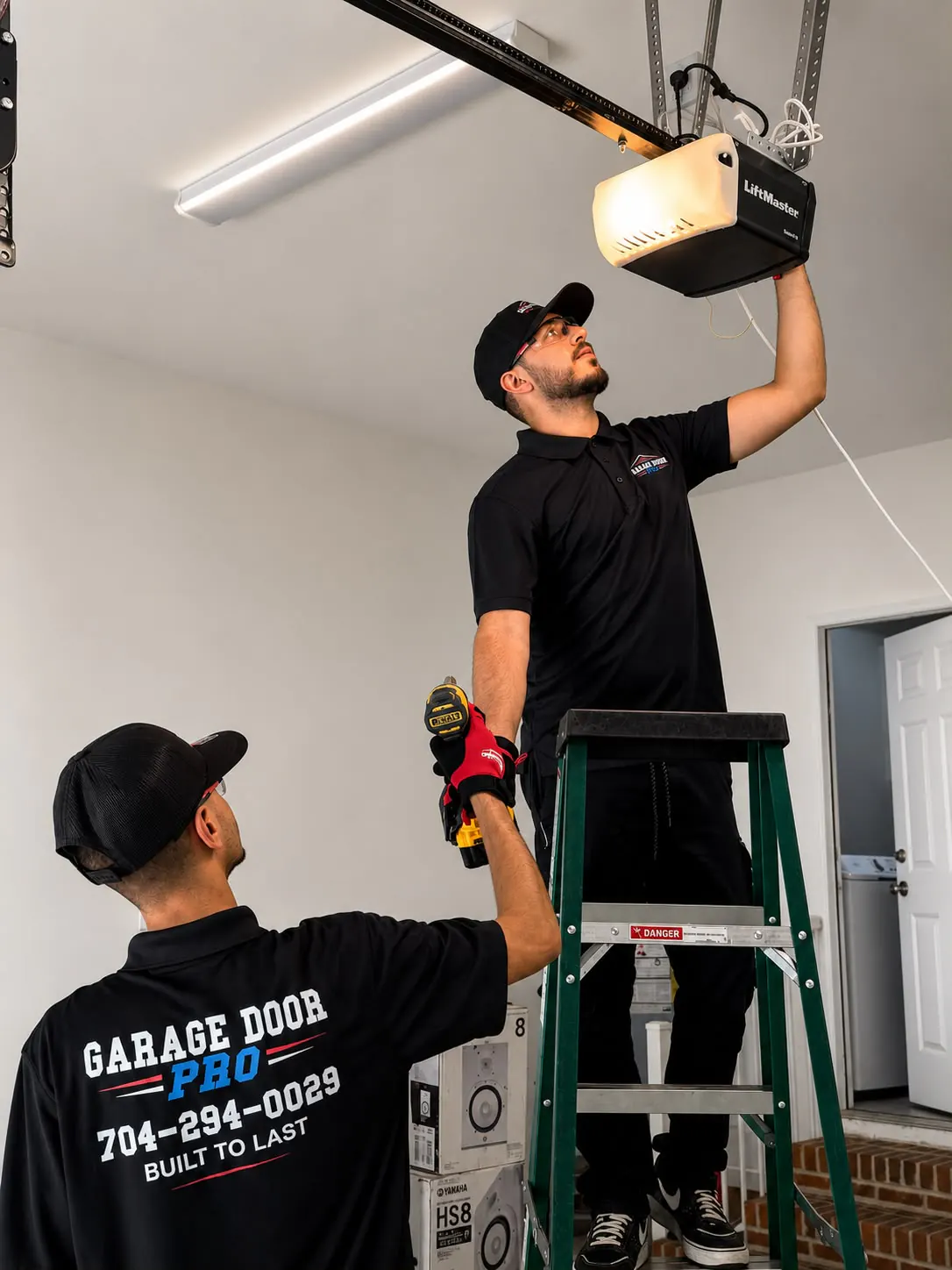
Short answer: choose the drive type first and the brand second. A belt drive is the quiet choice for a garage under or next to a bedroom. A chain drive is the rugged, budget-friendly workhorse for a heavy door that is used a lot. A screw drive has very few moving parts. A wall-mount (jackshaft) opener frees up the ceiling and cuts noise and vibration. LiftMaster, Chamberlain and Genie all make reliable openers in most of these styles. What matters more than the logo is that the opener suits your door and garage, has working safety sensors, and is installed on a door that is properly balanced.
We install and repair LiftMaster, Chamberlain and Genie openers, so this guide is about helping you pick the right type, not selling one brand.
What are the main types of garage door opener?
| Drive type | How it moves the door | Noise | Good fit for |
|---|---|---|---|
| Belt drive | A reinforced rubber belt in the rail | Very quiet | Attached garages, rooms above or beside the garage |
| Chain drive | A metal chain in the rail | Louder | Heavy doors, frequent use, detached garages |
| Screw drive | A threaded steel rod in the rail | Moderate | Owners who want few moving parts |
| Wall-mount (jackshaft) | A motor beside the door turns the torsion shaft | Quiet, less vibration | High or cathedral ceilings, storage racks, low clearance in the middle |
When is a belt-drive opener the right choice?
Belt drives are the usual recommendation when noise matters. LiftMaster’s buyer’s guide calls its belt-drive models virtually silent and suggests them for garages attached to the house. Genie’s explanation is that belt drives are smooth because there is no metal-on-metal contact in the rail. If there is a bedroom over the garage, a nursery next to it, or you leave early in the morning, a belt drive is worth considering.
When is a chain-drive opener the better option?
Chain drives are the traditional design. Genie describes them as among the most affordable openers and calls the design rugged and time-tested. LiftMaster points to chain drives for heavy doors that get used often. They are louder than belt drives, which matters less in a detached garage or a garage with no living space nearby.
What about screw-drive openers?
Genie’s screw-drive openers use a solid steel direct drive with no belts, chains or gears to wear out, and the motor drives the screw directly. Fewer moving parts is the main selling point. Like any rail-mounted opener, the rail still runs down the middle of the ceiling.
Why choose a wall-mount (jackshaft) opener?
A wall-mount opener sits on the wall beside the door and turns the torsion spring shaft directly, so there is no rail across the ceiling. LiftMaster notes that this frees up ceiling space and reduces noise and vibration. It is a good fit for garages with high ceilings, overhead storage, or a car lift. It does need a torsion spring system and the right side clearance, which we check before recommending one. If you are not sure which springs your door has, see our torsion vs. extension springs guide.
How do LiftMaster, Chamberlain and Genie compare?
All three brands are widely used and well supported, and parts are easy to get. A few practical points:
- LiftMaster is typically sold and installed by professional dealers and installers. It offers belt, chain and wall-mount models.
- Chamberlain is the sister brand of LiftMaster (both are made by The Chamberlain Group) and is more often sold in retail stores. Many of its features, including the myQ phone app, overlap with LiftMaster’s.
- Genie makes belt, chain and screw-drive openers. Genie quotes opening speeds of 6 to 12 inches per second across its range, with its fastest models at the top of that band.
Within each brand the gap between the entry model and the top model is bigger than the gap between brands. Compare the drive type, the motor and the features you actually want rather than the name on the box.
How do you match an opener to your door?
Before comparing models, check a few things about your door and garage:
- Door size and weight. Larger, heavier doors, such as insulated two-car doors or wood doors, are better suited to a stronger motor and a sturdy drive. Even so, the door must be balanced by its springs first.
- Door height. Standard rails suit a standard-height door. Taller doors may need a longer rail or an extension kit, so check the opener’s specifications.
- Ceiling space. A rail-mounted opener needs clear space down the middle of the ceiling and a little clearance above the door’s highest point. If that space is taken by storage or a low beam, a wall-mount unit may be the answer.
- Spring type. Wall-mount openers need a torsion spring shaft. Rail-mounted openers work with either spring type.
- Power and lighting. The opener needs an outlet on the ceiling (or near the door for a wall-mount), and you may want lighting in the unit if the garage is dark.
- How the garage is used. A door that is the main way in and out of the house gets far more cycles than one opened twice a day, so durability matters more.
We check all of this during a free estimate and tell you which options suit your garage before you buy anything.
Which features are worth paying for?
- Smart phone control. Apps such as myQ (LiftMaster and Chamberlain) let you open, close and check the door from your phone. We set up myQ during installation if you want it.
- Battery backup, so the door still works during a power cut.
- A soft start and stop, which is easier on the door and quieter.
- Built-in or brighter lighting if your garage is dark.
- A keypad outside so nobody needs a remote to get in.
What safety features does every opener need?
Federal rules require automatic residential openers to reverse when they meet an obstruction, and to carry extra entrapment protection such as photoelectric sensors. The Consumer Product Safety Commission explains that openers made before the early 1990s may lack these features and should be replaced. On a new opener, make sure:
- The safety sensors are mounted a few inches above the floor on both sides of the door and aimed at each other
- The door reverses when it closes on a 2x4 laid flat on the floor (the CPSC’s recommended monthly test)
- The manual release works, so the door can be opened by hand in an emergency
- The wall button is mounted high enough that small children cannot reach it
Should you repair or replace your opener?
Repair is usually worth it when the problem is a remote, keypad, sensor, limit setting or a single worn part such as a gear or a trolley. Replacement makes more sense when the opener is old enough to lack modern safety features, when it fails the reverse test even after adjustment, when parts are hard to get, or when you want features it cannot offer, such as a quiet belt drive or phone control.
One point is often missed: an opener does not lift the door’s weight. The springs do. If your door is heavy or out of balance, a new opener will strain and wear out early. We check the springs and the balance on every opener job.
How is a new opener installed?
A proper installation includes mounting the motor and rail (or the wall unit), fitting the sensors and wall button, programming remotes and any keypad, setting the travel limits and force, connecting myQ if wanted, and testing the reverse. We also install openers that customers have bought themselves. Garage Door Pro is licensed & insured, estimates are free and the price is agreed before work starts.
See our garage door opener service for repairs, replacements and installation. If your opener is acting up, our guide to why a garage door won’t close covers the common causes. Ready to choose? Contact us for a free estimate.
Frequently asked questions
What is the quietest type of garage door opener?
Belt-drive and wall-mount (jackshaft) openers are the quiet options. LiftMaster describes its belt drives as virtually silent, and Genie notes belt drives have no metal-on-metal contact in the rail. Wall-mount units also move the motor off the ceiling above the garage.
Will a new opener fix a door that is hard to lift?
No. The springs carry the door's weight, not the opener. If the door is heavy or out of balance, fix the springs first; otherwise a new opener will wear out early.
Can you install an opener I bought myself?
Yes. We install openers customers have bought, and we check the door's balance, the sensors and the reverse function as part of the job.
Can you set up the phone app?
Yes. We set up myQ on compatible LiftMaster and Chamberlain openers as part of the installation if you want it.
Sources
- LiftMaster: Garage door opener buyer's guide
- Genie: What's the difference between belt drive, screw drive and chain drive?
- U.S. Consumer Product Safety Commission: Non-reversing automatic garage door openers are a hazard
- eCFR: 16 CFR Part 1211, Safety standard for automatic residential garage door operators