
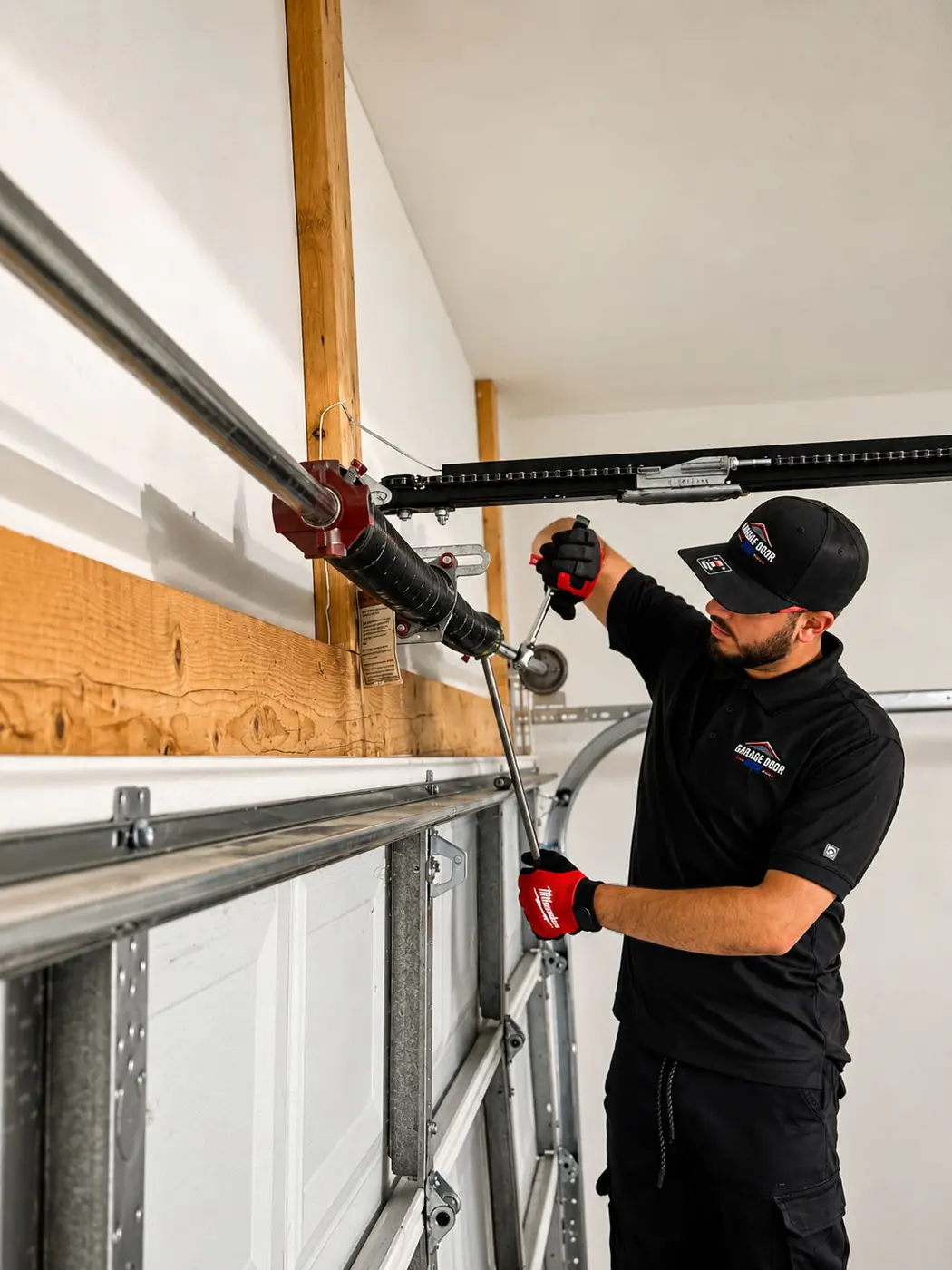
Short answer: both kinds of spring do the same job, which is carrying most of the door’s weight so you (or the opener) only have to lift a little of it. They do it differently. A torsion spring is a coil wrapped around a metal bar across the top of the door opening, and it works by winding up. Extension springs are long coils that run alongside the horizontal tracks, one on each side, and they work by stretching like a rubber band. To find out which one you have, stand inside the garage with the door closed and look up: a coil on a bar right above the door means torsion; coils running back toward the ceiling beside the tracks mean extension.
The rest of this guide covers how each system behaves, the safety points that matter for each, and when it is worth switching from one to the other.
How do you tell which springs your garage door has?
With the door closed (never study springs with the door open and the opener running), look at two places:
- Directly above the top of the door. If you see a horizontal steel bar with one or two large coils on it, plus a round drum at each end where the lift cables wind on, you have a torsion system. Some doors have a single spring in the middle; heavier doors often have two.
- Above each horizontal track. If you see long coils running from near the door toward the back of the garage, with a pulley at the door end and a cable running through the pulley, you have extension springs.
There are also enclosed torsion systems, where the spring sits inside the shaft or a tube and you cannot see the coil at all. If you see a tube across the top with no visible coil and no springs along the tracks, it is probably one of those.
How do torsion springs work?
A torsion system stores energy by twisting. When the door is down, the spring is wound tight. As the door rises, the spring unwinds and turns the shaft, the drums at each end wind the lift cables, and the cables pull the bottom corners of the door up together. Because both sides are driven by the same shaft, a torsion door tends to rise evenly.
The tension is set with winding bars inserted into a winding cone at the end of the spring. That is the part people get hurt on: a fully wound spring holds a lot of energy, and if a bar slips, it spins with that energy behind it. The door industry is clear that this is technician work.
How do extension springs work?
Extension springs store energy by being stretched. With the door down, the springs are pulled long. As the door opens, they contract, and the cables running over the pulleys lift the door. Each side has its own spring, so if the two springs are not matched or one is weaker, the door can rise unevenly.
Extension springs have one specific risk: when a stretched spring breaks, the pieces can fly. That is why each extension spring should have a safety containment cable threaded through it and fixed at both ends. DASMA’s safety advice says extension springs should always have these cables. If you see extension springs with no cable running through the middle, that is worth fixing even if nothing is broken yet.
How do they compare side by side?
| Torsion springs | Extension springs | |
|---|---|---|
| Where they sit | On a shaft above the door opening | Above each horizontal track |
| How they store energy | Twisting (winding) | Stretching |
| Number on a door | Usually one or two | Usually two, one per side |
| Lift behaviour | Both sides driven by one shaft | Each side has its own spring |
| When one breaks | Spring stays on the shaft | Needs a safety cable to contain it |
| Headroom needed | Some space above the door for the shaft | Very little above the door |
| Adjusting tension | Winding bars, technician only | Repositioning hardware, technician only |
| Good fit for | Garages with room above the door | Garages with little room above the door |
Which type is better?
Where there is enough headroom above the door, torsion springs have two practical advantages: the shaft keeps both sides of the door moving together, and a broken torsion spring stays on its shaft rather than coming loose. Extension springs remain a perfectly workable system, especially in garages with very little room above the door, provided they are matched, correctly tensioned and fitted with safety cables.
“Better” also depends on the specific spring. A well-matched extension setup in good condition is safer than a worn, wrongly sized torsion spring. What matters most is that the spring is right for your door’s weight and that the door balances: lift it halfway by hand (with the opener disconnected) and it should stay roughly where you leave it.
Is it worth converting from extension to torsion?
Converting means removing the extension springs, pulleys and cables and installing a shaft, torsion springs, drums, bearing plates and new cables. It can make sense when:
- Your extension springs have broken and you are paying for a full spring job anyway
- The door rises unevenly or keeps coming out of adjustment
- You want to get rid of the springs and pulleys hanging over the tracks
- You have enough headroom above the door for a shaft
It does not make sense when headroom is too tight, or when the existing extension setup is in good shape and just needs a matched pair of springs and safety cables. We will tell you honestly which applies to your garage, give you a free estimate for both options and show the price before any work.
What wears springs out?
Springs wear with every open and close cycle. A spring rated for a certain number of cycles will reach that number sooner on a door that is used many times a day than on a door that is opened twice. Other things that shorten spring life:
- Rust, which roughens the coils and adds friction. A light spray lubricant on the coils helps; DASMA mentions lubricating springs as part of routine care.
- An out-of-balance door, which makes the spring and the opener work harder.
- Mismatched springs, where one side does more of the work.
- Added weight on the door, such as new windows or insulation, without resizing the springs.
How do you know a spring is about to fail?
Springs often break without warning, but some signs are worth noticing: a visible gap or stretched section in a torsion coil, extension springs that look longer on one side than the other, a door that has started to feel heavier, rise unevenly or fail the halfway balance test, or squeaking and grinding from the spring area. If you notice any of these, do not try to adjust the tension yourself. Request a check instead.
Why should only a technician replace springs?
Both spring types hold the door’s weight in stored energy. DASMA’s guidance states that springs are the most dangerous part of a garage door and that spring work should be left to a trained door systems technician. The same applies to the bottom brackets and cables connected to them, which are under tension too. If your door has two springs and one breaks, DASMA recommends replacing both.
Our trucks carry common torsion and extension springs, so most replacements are done on the first visit. Garage Door Pro is licensed & insured, estimates are free and you see the price before any work begins. Read more on our garage door spring repair page. Ready to book? Contact us.
Frequently asked questions
Which lasts longer, torsion or extension springs?
It depends on the spring's wire size and design rather than the type alone. Both kinds wear out with use. Longer-life versions of both exist; ask for the cycle rating of the spring you are being offered.
Can I convert from extension to torsion springs?
On most residential doors, yes, if there is enough headroom above the door for the shaft. It is a bigger job than a spring swap because the shaft, drums and bearing plates are new. We can tell you on site whether your garage has the room and what it would cost, before any work.
Do I need safety cables on extension springs?
Yes. A safety cable runs through the middle of each extension spring so that if the spring breaks it cannot whip across the garage. DASMA's safety advice says extension springs should always have them.
Can I tell the spring size from its colour?
Only partly. Some manufacturers paint spring ends to show size, but the industry's spring identification sheet warns that colour codes give partial identification only. Springs are properly matched by measuring wire size, inside diameter and length.